Wildebeests Facts.
The Beating Heart of the Savannah and the Giants Behind the Great Migration
Wildebeests, or gnus as they are sometimes called, are among the most recognized and influential animals in the African wilderness. Their rugged appearance, unpredictable behaviour, overwhelming numbers, and dramatic annual migration make them one of the greatest spectacles of nature. Each year, more than a million wildebeests, accompanied by zebras and gazelles, move across the Serengeti–Mara ecosystem in a continuous loop that shapes landscapes, feeds predators, and fuels tourism economies across Kenya and Tanzania.
Yet, wildebeests are often misunderstood. To some, they appear awkward or comical, with their large heads, sloping backs, and high shoulders. But to ecologists, conservationists, and safari enthusiasts, these animals are nature’s engineers—resilient, intelligent, and perfectly designed to thrive in some of Africa’s most dynamic environments.
In this comprehensive blog, we explore the story of the wildebeest: their biology, behavior, lifecycle, predators, migration, ecological importance, conservation status, and where you can witness them in East Africa. Whether you’re planning a safari or simply curious about African wildlife, this deep dive reveals why wildebeests are the beating heart of the savannah.
- Introduction: The Symbol of the African Wilderness
Wildebeests are synonymous with East Africa’s open plains. They represent movement, survival, and the timeless rhythms of nature. Their dramatic migration defines the seasons, influences vegetation patterns, controls predator populations, and provides one of the most thrilling wildlife experiences in the world.
To understand the significance of wildebeests is to understand the savannah itself. Without them, the Serengeti and Maasai Mara would look drastically different. Grasslands would grow differently, predators would decline or relocate, and the tourism sector would lose one of its most powerful attractions.
They are more than animals; they are storytellers of the wild, carrying ancient instincts and shaping the natural world with every hoofbeat.
- Species Overview: What Exactly Is a Wildebeest?
There are two primary species of wildebeests:
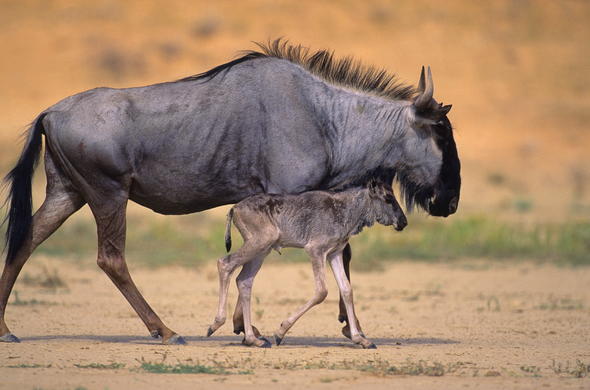
Blue Wildebeest (Connochaetes taurinus)
This is the species found in East Africa, dominating the Serengeti–Mara ecosystem. They have:
- A deep grey-blue body
- Dark facial markings
- A black beard
- Curved horns in both sexes
- Stripes along their ribs
Tall and muscular, they are built for endurance rather than beauty—perfect migrators.
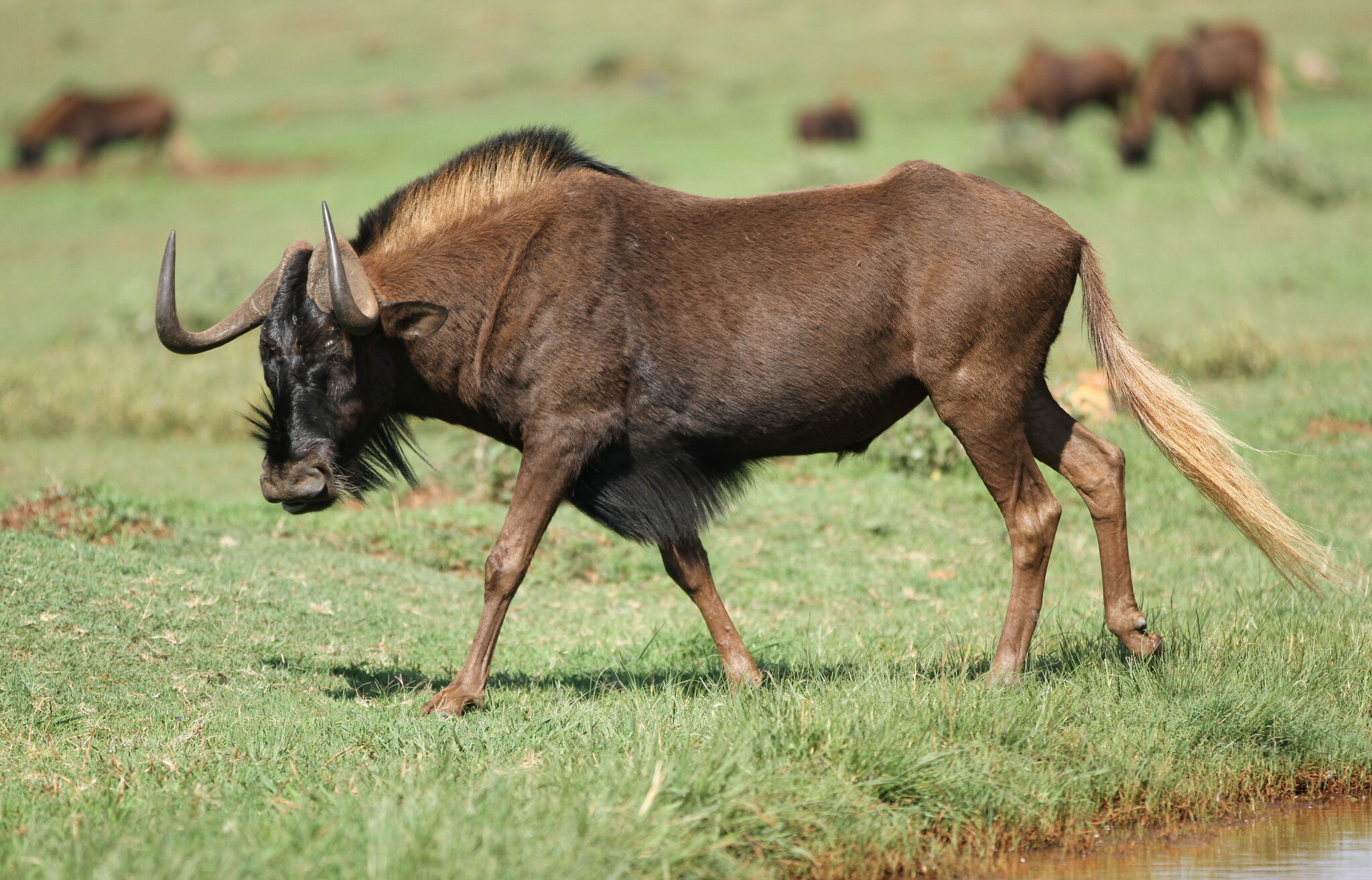
Black Wildebeest (Connochaetes gnou)
Found mainly in southern Africa, this species has:
- A chocolate-brown to black coat
- A long white tail
- Forward-curving horns
Though impressive, they do not participate in the Great Migration.
Why Wildebeests Look the Way They Do
Their unusual body structure—large shoulders, sloping back, sturdy legs—supports long distances and sudden bursts of speed. Their powerful sense of smell and hearing allow them to detect predators and rain patterns from far away.
In many ways, wildebeests are designed for constant motion.
- Social Behaviour: Life Inside the Herd
Wildebeests live in highly structured herds that can range from a few dozen individuals to tens of thousands depending on the season.
Herd Structure
- Breeding herds consist of females, calves, and several adult males.
- Bachelor herds include young or non-dominant males.
- Territorial bulls defend small patches during mating season.
Despite these divisions, herds merge and separate fluidly, forming enormous mobile communities.
Communication and Coordination
Wildebeests communicate through:
- Grunts
- Snorts
- Alarm calls
- Body movements
A single grunt can trigger movement across a cluster of thousands.
Daily Rhythms
Wildebeests spend most of their day:
- Grazing
- Moving
- Resting
- Avoiding predators
- Drinking when water is available
Their behaviour is dictated almost entirely by food and safety—key drivers of migration.
- Reproduction and Early Life: The Miracle of Calving Season
The reproductive strategy of wildebeests is one of nature’s most fascinating displays of timing and instinct.
The Rut (May–June)
During the mating season:
- Males fight violently for territory
- Females choose the strongest bulls
- The plains become a chorus of grunts and clashes
Dominant bulls mate with multiple females before the herd moves on.
Calving (late January to early March)
Eight months after mating, something extraordinary happens:
Over 400,000 calves are born in just 2–3 weeks in the southern Serengeti and Ndutu region.
Benefits of synchronized birth include:
- Predators are overwhelmed
- Calves can join the herd quickly
- The timing coincides with mineral-rich grasses that support lactation
Calf Development
- 7 minutes: Most calves stand
- 1 hour: They walk
- 1 day: They run
- 1 week: They can keep up with the herd
This rapid development is essential for survival.
- The Great Migration: Nature’s Largest Land Mammal Movement
The Great Migration is the defining feature of wildebeest life—and one of Earth’s most incredible natural events. It spans over 1,000 kilometres in a circular pattern through Tanzania and Kenya.
Why They Migrate
The migration isn’t just a spectacle; it’s a survival mechanism. Wildebeests follow:
- Fresh rain
- New grasses
- Mineral-rich soils
- Water sources
Their movement supports thousands of predators and impacts the lives of numerous other species.
The Migration Cycle
- December–March: Southern Serengeti (Calving Season)
Calves are born on the open plains where visibility is high, providing some protection against predators.
- April–May: Central Serengeti
As rains shift, so do the herds. This period sees long lines of wildebeests moving northwards.
- June: Western Corridor
The herds gather near the Grumeti River—home to massive crocodiles. Early river crossings begin here.
- July–August: Mara River Crossings
This is the migration’s climax. Thousands push through the treacherous Mara River:
- Strong currents
- Steep banks
- Nile crocodiles
- Panic-driven stampedes
It is raw, emotional, and unforgettable.
- September–October: Life in the Maasai Mara
Green grass in Kenya’s Mara sustains the herds, making this one of the best wildlife viewing seasons on Earth.
- November: Return to Serengeti
With the arrival of short rains, wildebeests begin their journey back, completing the cycle.
- Predators: The Constant Threat
Wildebeests are central to predator survival in the Serengeti–Mara ecosystem.
Major Predators
- Lions: Target weak adults and calves
- Hyenas: Highly successful hunters of wildebeests
- Leopards: Prefer calves or isolated individuals
- Wild dogs: Efficient and relentless
- Cheetahs: Hunt calves during calving season
- Crocodiles: Lethal during river crossings
Predators shape wildebeest movement patterns, forcing them to remain alert and mobile.
- Ecological Importance: Wildebeests as Nature’s Engineers
Wildebeests are among the most ecologically important animals in East Africa.
Grassland Management
Their grazing:
- Controls tall grasses
- Helps new grass sprout
- Maintains open plains
- Reduces wildfires
Without them, the ecosystem would shift toward bushland.
Nutrient Recycling
Wildebeests deposit huge amounts of dung across the plains, enriching soils and supporting plant regeneration.
Food Web Support
Their presence ensures:
- Predators thrive
- Scavengers have access to carcasses
- Vultures feed on remains
- Soil organisms increase biodiversity
Water Redistribution
Their movements determine:
- Waterhole usage
- Wetland dynamics
- Vegetation near rivers
Ecologically, wildebeests are keystone species.
- Best Places to See Wildebeests in East Africa
Kenya
- Maasai Mara National Reserve
- Mara Triangle
- Private conservancies
Best viewing: July to October
Tanzania
- Serengeti National Park
- Ndutu region (Ngorongoro Conservation Area)
- Western Corridor
Best viewing:
- Calving: January to March
- Movements north: April to June
- Return south: November
- Wildebeests and East African Tourism
Safari tourism relies heavily on wildebeests:
- River crossings attract global attention
- Documentaries showcase migration drama
- Photographers seek massive herds
- Local communities earn tourism revenue
The migration sustains thousands of jobs and contributes significantly to conservation funding.
- Conservation Status and Challenges
While classified as Least Concern, wildebeests face modern threats:
Major Challenges
- Habitat loss
- Fencing that blocks migration paths
- Climate change altering rainfall
- Expanding agriculture
- Road construction
- Predation pressure in constrained areas
What Is Being Done
Kenya and Tanzania have:
- Protected migration routes
- Expanded conservancies
- Strengthened anti-poaching efforts
- Encouraged community-based wildlife management
Wildebeests remain abundant, but protecting their migratory freedom is critical.
- Fun and Fascinating Facts
- Wildebeests can run up to 80 km/h.
- Their name “gnu” comes from their grunting call.
- They often migrate with zebras, benefiting from each other’s grazing patterns.
- A single herd can stretch 30 kilometres long.
- Calves recognize their mothers within hours by voice and smell.
- Conclusion: Why Wildebeests Matter
The wildebeest is more than a mere antelope—it is one of the greatest forces of nature. Its survival strategies, herd behaviour, and migration instincts form the backbone of one of Earth’s most complex ecosystems. Their annual journey connects landscapes, sustains predators, enriches soil, and inspires millions of travellers from around the world.
To watch a herd rumble across the plains or witness a river crossing is to experience the raw, untamed spirit of Africa. The wildebeest teaches us that survival lies in unity, movement, and adapting to nature’s rhythm.
Whether you are planning a safari or simply admiring wildlife from afar, understanding the wildebeest is understanding East Africa itself.